

The Longest Extra Time
How a World Cup match reunited a Peace Corps Volunteer and her student 35 years later
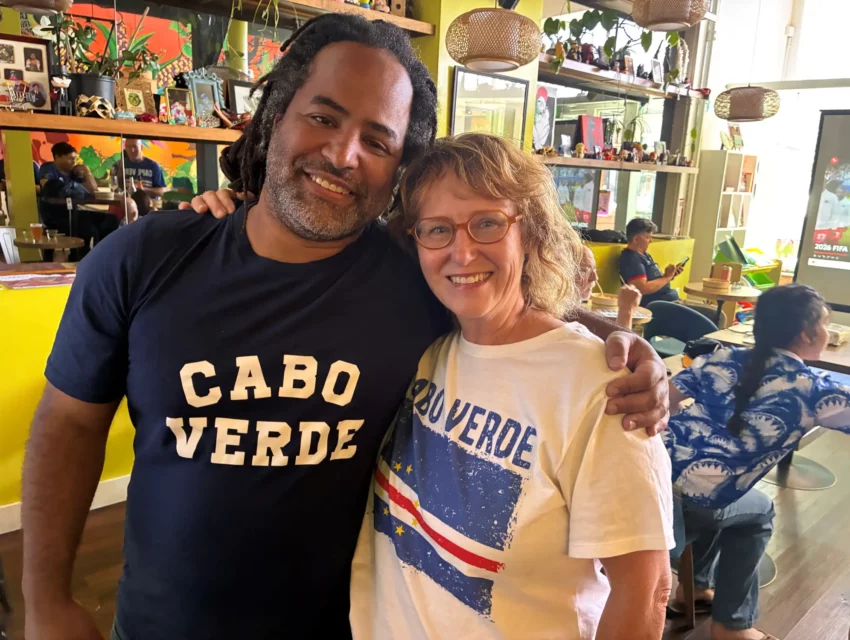
Jill Tucker sat quietly in a bar, watching the World Cup match unfold on the TV with everyone else, when a man sitting nearby addressed her: “You were my teacher.”
Tucker had served the Peace Corps in 1990, teaching English for two years in the Capital of Cape Verde, Praia. Thirty-five years later, Ivan, a student in her class, wound up at the very same bar that night, watching the World Cup, too.
When Tucker finished her Peace Corps service in 1992, there was no video call or social media to keep her connected to her students or the friends she made in Praia. She left thinking that in all likelihood she would never see her hosts again.
After returning to the States, she became an education reporter for the San Francisco Chronicle, inspired by her years teaching English in Cape Verde.
Tucker never imagined she would become a journalist. In fact, the year she joined the Peace Corps, she had also been accepted to law school. While her family encouraged her to follow that path, Tucker envisioned another.
She woke up one day with a strong gut feeling that the Peace Corps was the right choice, and she’s never looked back.
While her service years were at times challenging and lonely, they were also marked by periods of happiness and growth. This mix of up and down, good and bad, is what makes those years stand out in her memory as life-changing.
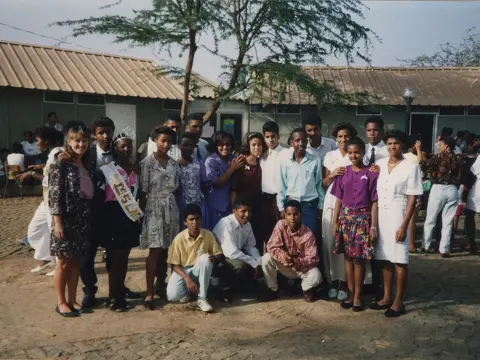
San Francisco Chronicle reporter and RPCV Jill Tucker with Ivan at her site in Cape Verde
Tucker recalls the small things and the accumulation of ordinary days as what made the Peace Corps valuable, and what gave her the time and perspective needed to think about her future. It was in Cape Verde that she realized she wanted to become a journalist rather than a lawyer.
And so 35 years passed as Tucker pursued her aspirations in journalism, and wound up at a neighborhood bar one night to watch a World Cup match: Cape Verdge versus Uruguay.
It was at that moment Ivan recognized her. Tucker hadn’t seen Ivan or any of her students from those days since they were teenagers.
This marked the beginning of an organic reconnection for Tucker with her former host country. Ivan helped Tucker reconnect with her other former students, and she is now planning a Zoom call with them.
Ivan, it turned out, had lived not far from Tucker for the past 20 years, and used the pickleball courts near where she usually walked her dog. The student and teacher are now neighbors to each other, something Tucker had never anticipated.
Since meeting Ivan again, Tucker is now considering traveling back to Cape Verde for the first time in decades.
As Tucker reflects on that fateful decision to join the Peace Corps in 1990, she’s struck most by the unexpected ways it’s shaped her present — from her career choice to meeting a former student some 35 years later. “Some people don’t find things out until they’re on their deathbed. Others figure it out in the Peace Corps,” she says.
Luisa Gonzalez is a student at the University College London (UCL) and was a summer 2026 WorldView intern.


Related Articles

Why HBCUs Belong on Your Grad School List
One of the first things prospective students should understand is that there is no single HBCU graduate school experience. There…

On the Road to Kinale
A former Peace Corps Volunteer recalls a visit to Kinale, Kenya, where a fall on a muddy road led to…

Peter Pan Syndrome
As young idealists, we penetrated local society and understood day-to-day life in ways that neither Foreign Service diplomats nor graduates…

Carrying the Torch of Liberty
In the early 1960s, during the Pan American Games, a major international sporting event held every four years, my father…