For the first time in more than a quarter century, Peace Corps Volunteers are preparing to return to Solomon Islands.
by Riya Mehta
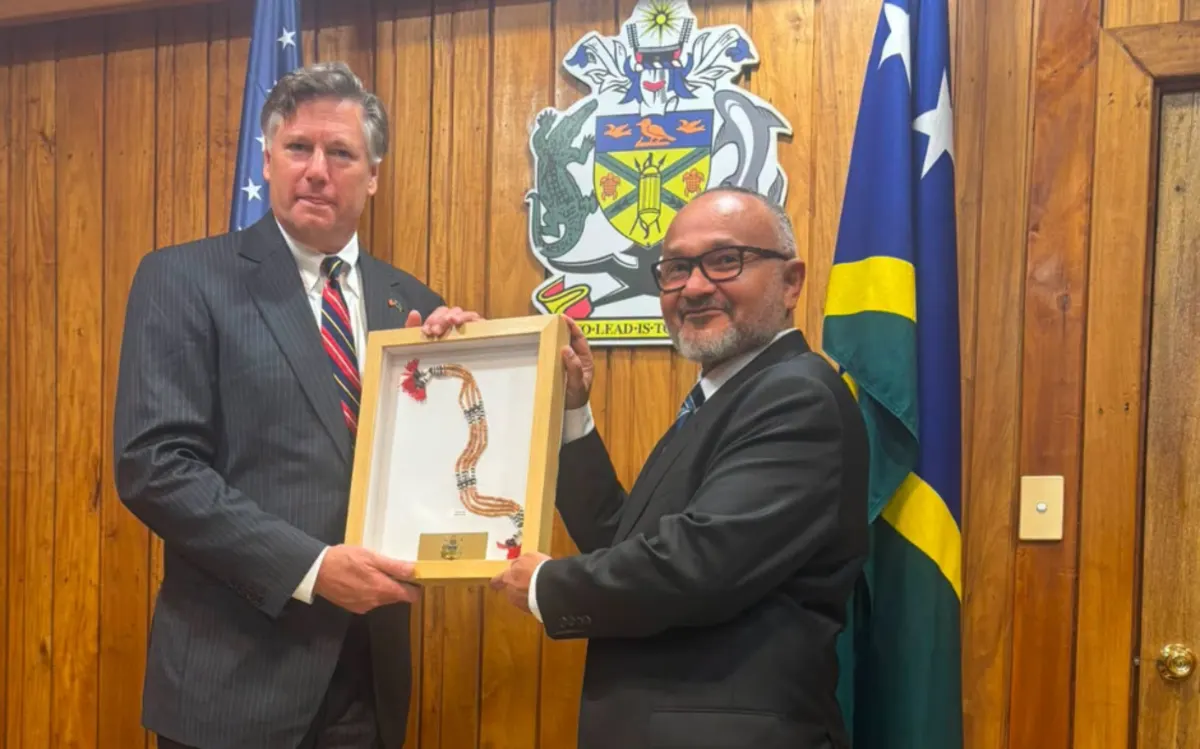
On September 6, Peace Corps Acting Director Christopher Landau and Solomon Islands Minister of Foreign Affairs and External Trade Rick Houenipwela signed a bilateral country agreement in Honiara to formally reestablish the Peace Corps program. The agreement renews a partnership that once brought more than 700 Volunteers to communities across the country and that has remained dormant since the program was suspended in 2000.
The first new group of Volunteers is expected to arrive in early 2028, initially working in education. Peace Corps staff and the Solomon Islands government will spend the intervening period identifying communities where Volunteers can contribute to locally determined priorities.
For Solomon Islands Prime Minister Matthew Wale, the agreement also revives memories of an earlier era of cooperation. Wale recalled Volunteers working in local communities and rural villages during the 1990s, including in education, health and sports.
“The return of the Peace Corps will revive fond memories of that partnership and further strengthen cooperation between our two countries,” Wale said following discussions with Landau.
A Partnership Interrupted
Peace Corps first sent Volunteers to Solomon Islands in 1971. Over the following 29 years, more than 700 Americans served alongside Solomon Islanders, working primarily in education, health and community economic development.
That work came to an abrupt halt in 2000.
Amid political instability and ethnic tensions, Peace Corps announced on June 20th that it was suspending operations. All 64 Volunteers then serving in Solomon Islands, along with American staff, were safely relocated to neighboring Vanuatu. At the time, Peace Corps Director Mark Schneider said the agency hoped circumstances would permit a quick return.
The interruption would ultimately last much longer.
Although the program was formally closed in 2008, the relationship was not forgotten. Solomon Islands formally invited Peace Corps to return in 2019 and renewed that invitation in 2026. In July of this year, Landau and Wale signed a letter of intent laying the groundwork for the agency’s return. The September agreement now moves that process to make another significant step forward.
For Houenipwela, the renewed program is to be centered on Solomon Islands’ own development needs.
“This agreement is a practical expression of a broader truth: that Solomon Islands values genuine partnership,” he said at the signing, describing a relationship grounded in respect for the country’s sovereignty and priorities.
He added that RPCVs could eventually expand capacity in classrooms, support health workers and facilitate skills sharing within communities.
Peace Corps Program Manager of RPCV engagement at Peace Corps Sarah Rupert holds up a newspaper announcing Peace Corps’ return to the Indo Pacific Nation. [Photo Credit: Sarah Rupert]
Returning to a Changing Pacific
The Peace Corps return is also taking place in a Pacific region that looks considerably different from the one Volunteers left in 2000.
In recent years, Pacific Island countries have received increased diplomatic attention from the United States and other international powers as countries like China, Australia and even Japan seek to expand their presence in the region. Against that backdrop, Peace Corps’ model of living and working within host communities represents a distinctly people-to-people form of international engagement.
The United States itself has deep historical ties to the Pacific, forged in part through the battles of World War II—including the Guadalcanal campaign in Solomon Islands—and sustained in the decades since through diplomatic, development and security partnerships across the region.
Peace Corps, she noted, has a remarkably deep history in the region: more than 14,500 Volunteers have served in 16 Indo-Pacific countries since the agency’s founding. In some Pacific island nations, Volunteers were for years the only U.S. government presence regularly living and working within local communities.
Spahn also described hearing directly from Pacific leaders about the relationships created through those decades of service. Some remembered individual Volunteers who had taught them. Others described Peace Corps as something that had become intertwined with their communities.
“Peace Corps is a part of us,” Spahn recalled leaders telling her.
At the time of her 2024 remarks, Solomon Islands was among the countries Peace Corps had assessed for possible reentry. Spahn emphasized that reopening a program involves more than receiving an invitation. The agency examines host-government interest, community needs, potential areas where Volunteers can contribute, safety and security conditions, medical support and available resources before proceeding.
Two years later, that process resulted in a formal agreement.
Rebuilding Connections Across the Pacific
Solomon Islands is not the only Pacific country where Peace Corps is rebuilding its presence.
In July 2026, Volunteers officially returned to Palau for the first time since 2018. In September, Peace Corps also signed a letter of intent with the Federated States of Micronesia, the Marshall Islands and Palau, expressing mutual interest in creating a unified North Pacific Peace Corps program.
The Solomon Islands agreement forms part of a broader reengagement across a region where generations of Returned Peace Corps Volunteers maintain connections to the communities in which they once lived and served.
Yet the new Solomon Islands program will not simply recreate the one that ended 26 years ago. The Volunteers expected in 2028 will enter communities facing a different set of opportunities and challenges, and Peace Corps and the Solomon Islands government say their work will be shaped by current local priorities.
Education will be the initial focus. From there, the agreement leaves room for a partnership that can evolve alongside the communities involved.
Landau said the renewed program would help strengthen the longstanding relationship between the United States and Solomon Islands while allowing Volunteers and their counterparts to develop skills together.
For a program built around long-term relationships, the return carries significance beyond the arrival of a new cohort. The Volunteers of 2028 will be following a path first traveled and carved by Peace Corps Volunteers more than half a century earlier – while beginning a new chapter of their own.
Twenty-six years after the last Volunteers departed, Peace Corps is not simply arriving in Solomon Islands.
It is returning.
Check out the NPCA online store for this and other country of service tee shirts!